UK VAT Rates
UK VAT rates depend on the type of goods or services being supplied. The standard VAT rate is 20%, while some supplies qualify for the reduced 5% rate or the 0% rate. Some goods and services are exempt from VAT rather than being charged at 0%.
Choosing the correct rate matters when you are calculating VAT, checking an invoice, or working out the final price of a product or service. Using the wrong rate can change the VAT amount even when the calculation itself is correct.
This guide explains the main UK VAT rates, how they differ, and what to check before using a rate in a VAT calculation.
Current UK VAT Rate Categories
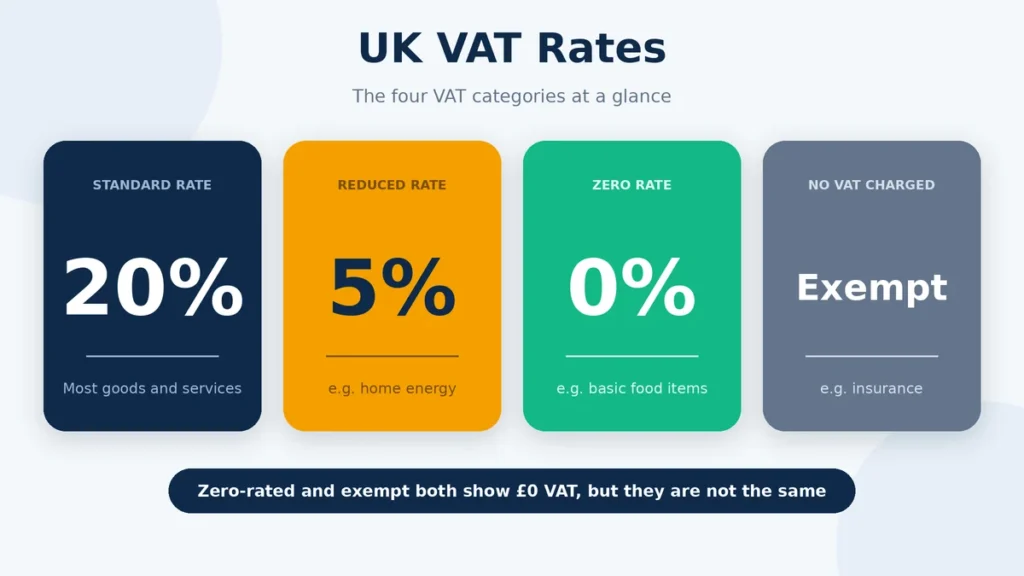
The UK has three main VAT rates for taxable goods and services: the standard rate of 20%, the reduced rate of 5%, and the zero rate of 0%. Some supplies are exempt from VAT rather than charged at 0%. The rate that applies depends on the specific goods or services and the conditions of the supply.The UK has three main VAT rates for taxable goods and services: the standard rate of 20%, the reduced rate of 5%, and the zero rate of 0%. Some supplies are exempt from VAT rather than charged at 0%. The rate that applies depends on the specific goods or services and the conditions of the supply.
| VAT Category | Rate | General Use |
| Standard rate | 20% | Most goods and services |
| Reduced rate | 5% | Some eligible goods and services |
| Zero rate | 0% | Certain zero-rated goods and services |
| Exempt | No VAT charged | Certain exempt goods and services |
For example, GOV.UK lists children’s car seats and some home energy supplies among items that can qualify for the 5% reduced rate, while most food and children’s clothes are examples of zero-rated goods. Some supplies, such as postage stamps and certain financial and property transactions, are exempt. The exact treatment should be checked for the particular product or service rather than assumed from its general category.
Which Goods and Services Use Each UK VAT Rate
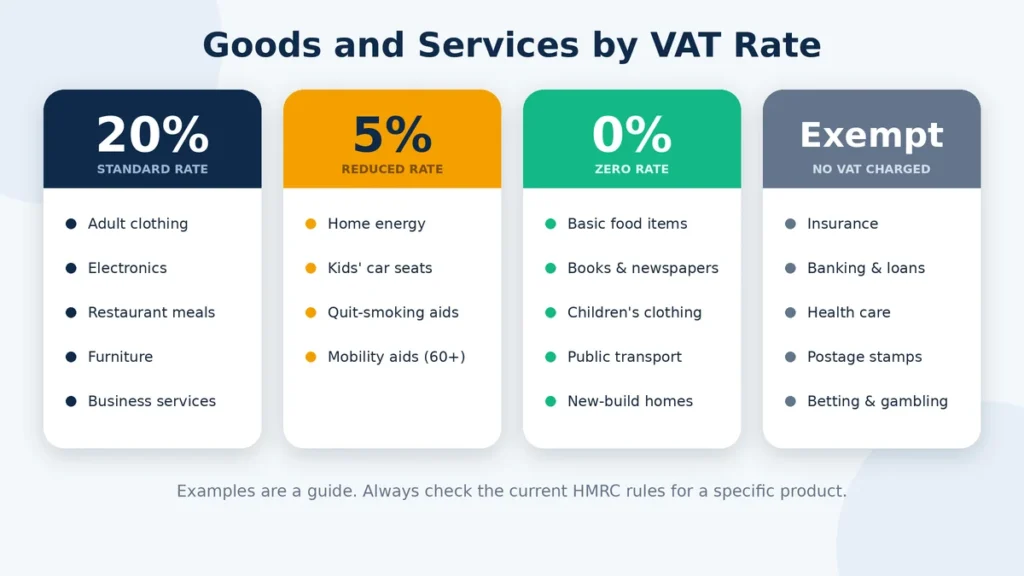
The VAT rate depends on what you are selling and the conditions that apply to the supply. Most goods and services use the standard 20% rate, while specific items qualify for 5% or 0%. Some supplies are exempt rather than zero-rated, so they should not be treated as a 0% VAT sale.
- 20% standard rate: Most goods and services sold by VAT-registered businesses.
- 5% reduced rate: Certain supplies, including some domestic fuel and power and children’s car seats.
- 0% zero rate: Certain goods such as most food and children’s clothing.
- Exempt: Certain supplies, including some financial services, insurance, education, and medical services.
The rate is not determined by the product name alone. Some goods and services have different VAT treatment depending on how they are supplied or the conditions of the transaction. Check the specific GOV.UK guidance before applying a rate to an invoice or VAT calculation.
Zero-Rated vs VAT-Exempt Supplies
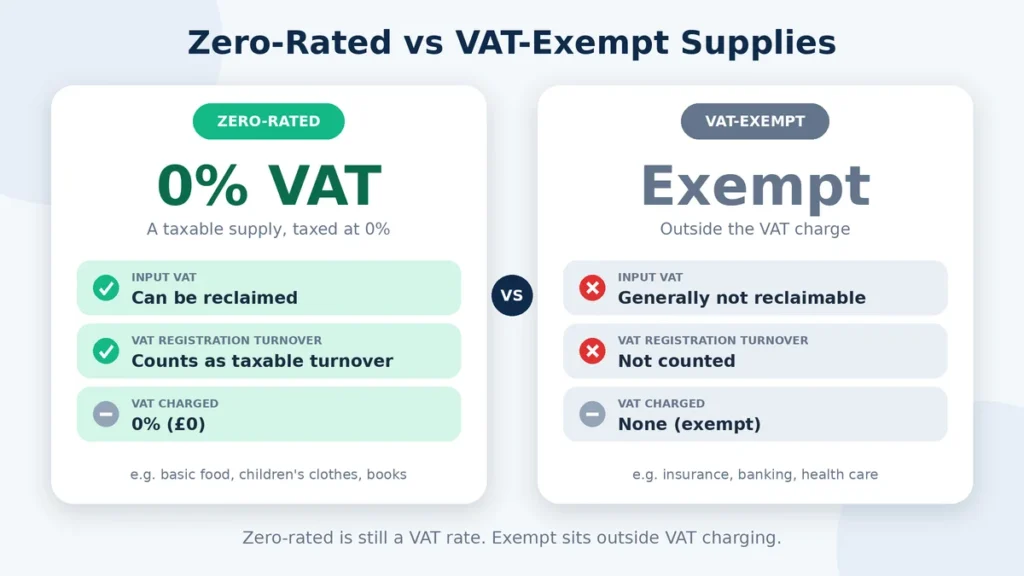
Zero-rated and VAT-exempt supplies can both have no VAT added to the customer’s price, but they are treated differently for VAT purposes. Zero-rated supplies are taxable at 0%, while exempt supplies are not taxable in the same way. This difference can affect whether a VAT-registered business can reclaim VAT on related purchases.
| Point | Zero-rated | VAT-exempt |
| VAT charged to customer | 0% | No VAT charged |
| Taxable for VAT | Yes | No |
| VAT rate | 0% | Not applicable |
| Input VAT recovery | Generally allowed, subject to normal rules | Generally restricted |
| Example | Most food and children’s clothes | Some insurance and financial services |
A zero-rated sale is still a taxable supply, even though the VAT rate is 0%. An exempt supply is treated differently. This is why you should not simply treat every transaction with no VAT as zero-rated. The correct treatment depends on the specific goods or service and the conditions that apply.
How UK VAT Rates Affect Price Calculations
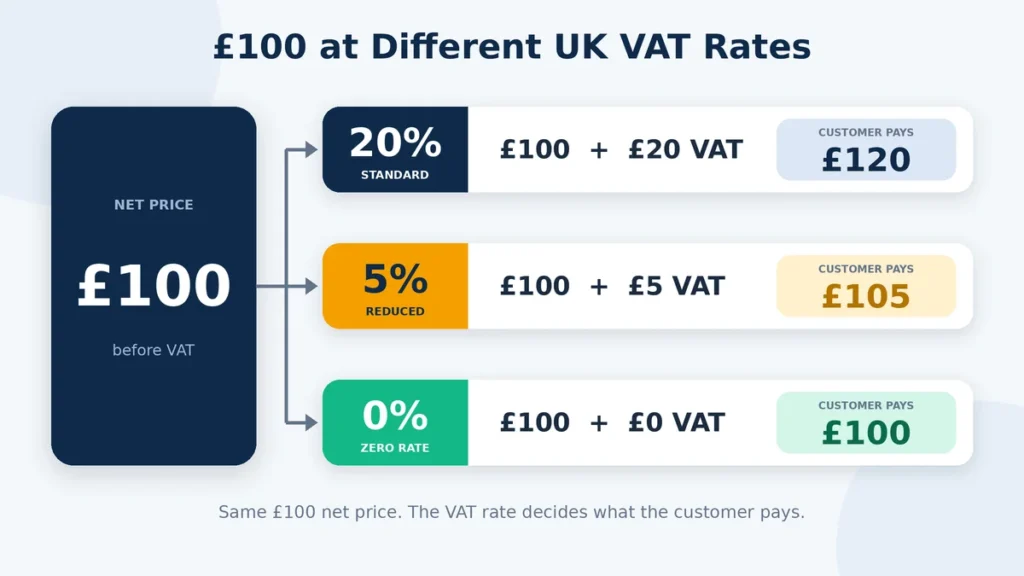
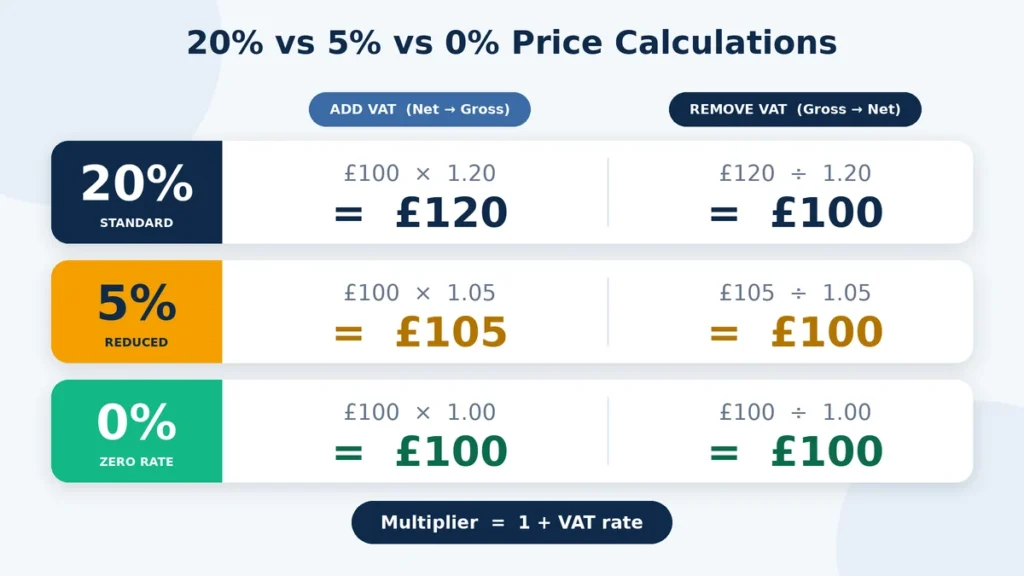
The VAT rate changes the final price when VAT is added to a VAT-exclusive amount. For example, a £100 price becomes £120 at 20% VAT, while the same £100 becomes £105 at 5% VAT. A zero-rated sale remains £100 because the VAT rate is 0%.
The calculation also works in reverse when VAT is already included. At 20% VAT, a £120 gross price contains £100 net price and £20 VAT. At 5%, a £105 gross price contains £100 net price and £5 VAT. This is why you need to know the applicable rate before adding VAT or separating it from a VAT-inclusive price.
When checking an invoice or setting a selling price, make sure the VAT rate matches the goods or service involved. The calculation may be simple, but using the wrong rate will give you the wrong final amount.
FAQs
Final Thoughts
UK VAT rates are easier to work with once you know which category applies to the goods or service. The standard rate is 20%, while some supplies use 5% or 0%. Exempt supplies are treated differently and should not simply be entered as zero-rated.
The rate can affect both the VAT amount and the final price, so check the VAT treatment before doing the calculation. This is especially important when a product has special conditions or an invoice contains more than one VAT rate.
For current rates and unusual transactions, GOV.UK is the place to check the latest HMRC guidance. VAT rules can change, and some temporary rates or special treatments may apply for limited periods.
When calculating VAT, have you checked the rate for the specific goods or service rather than assuming 20%?