Business VAT Calculator
A Business VAT Calculator helps you work out VAT on sales, purchases, and business prices. It can show the VAT amount, the price before VAT, and the final price after VAT, depending on the calculation you need.
For a business, getting the starting amount right matters. A price may be VAT-exclusive, meaning VAT still needs to be added, or VAT-inclusive, meaning the tax is already part of the displayed price. The calculation is different in each case.
A calculator can also make it easier to check quotes, invoices, product prices, and other business figures before using them in your records. The VAT rate still needs to match the goods or services being supplied because not every transaction is charged at the same rate. HMRC currently lists 20% as the standard VAT rate, with 5% and 0% applying to certain supplies.
Using a Business VAT Calculator for Sales and Purchases
A business VAT calculator can be used for many everyday pricing and accounting checks, including:
- Working out VAT on a sale price
- Finding the VAT included in a VAT-inclusive amount
- Checking the total price after VAT is added
- Reviewing VAT on business purchases
- Preparing quotes and estimates
- Checking figures shown on invoices
- Comparing costs before and after VAT
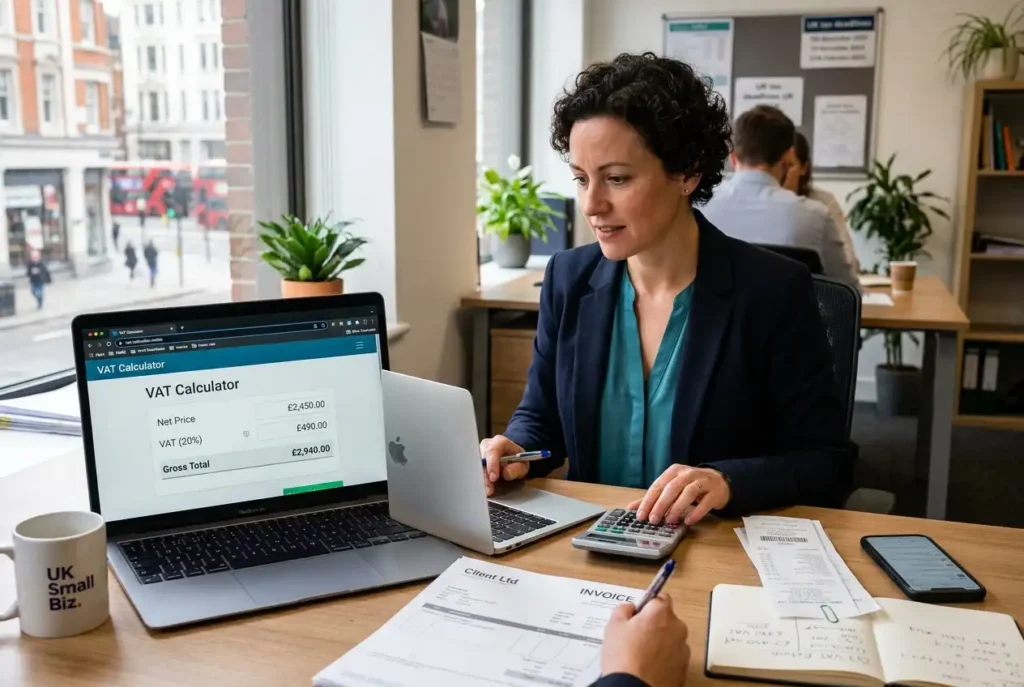
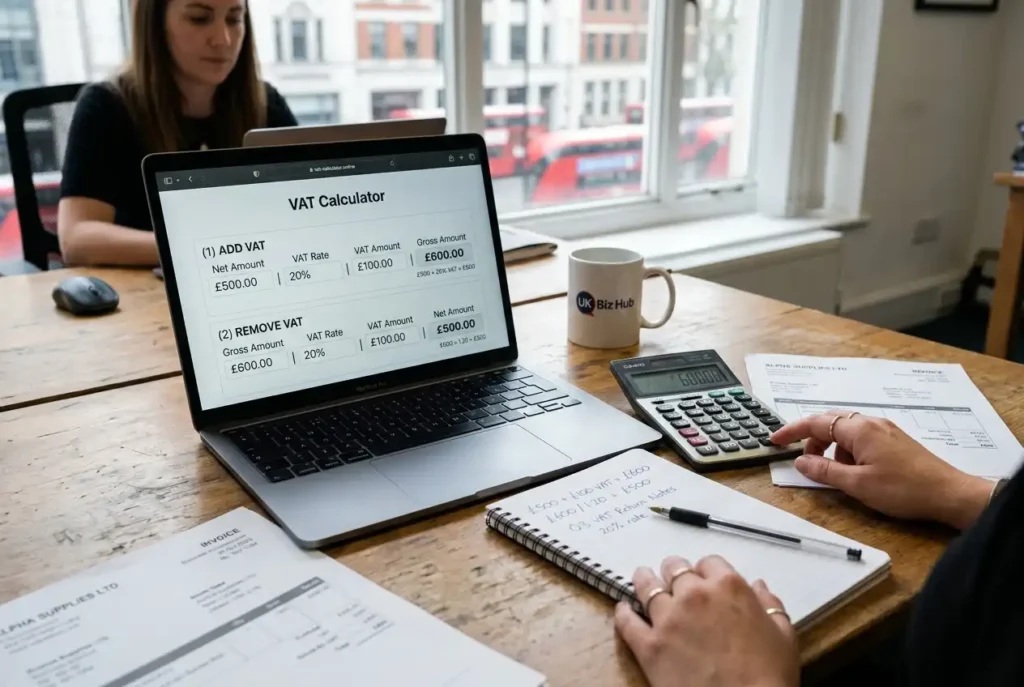
For example, if a product costs £500 before VAT and the applicable rate is 20%, the VAT is £100. The customer price would be £600 including VAT.
If you start with the £600 VAT-inclusive price, you can work backwards to find the £500 net amount and £100 VAT.
This makes the calculator useful when a business works with both VAT-exclusive supplier costs and VAT-inclusive customer prices.
Business VAT Calculation Formulas
The calculation depends on whether you are starting with a price before VAT or an amount that already includes VAT.
Add VAT to a Net Price
To add VAT to a price before VAT:
VAT amount = Net price × VAT rate ÷ 100
Gross price = Net price + VAT amount
Example:
£500 × 20% = £100 VAT
£500 + £100 = £600 including VAT
Remove VAT from a Gross Price
When the price already includes VAT, divide the gross amount by 1 plus the VAT rate as a decimal.
Net price = Gross price ÷ (1 + VAT rate ÷ 100)
For 20% VAT:
£600 ÷ 1.20 = £500 net price
The VAT included is:
£600 − £500 = £100 VAT
Find VAT Included in a Gross Price
You can find the VAT portion by subtracting the net price from the gross price.
VAT included = Gross price − Net price
For a 20% VAT-inclusive price, you can also use:
VAT included = Gross price × 20 ÷ 120
Example:
£600 × 20 ÷ 120 = £100 VAT
The remaining £500 is the price before VAT.
VAT-Inclusive vs VAT-Exclusive Business Prices
A VAT-exclusive price does not include VAT, so the applicable VAT needs to be added to find the final customer price.
A VAT-inclusive price already contains VAT. You cannot simply take 20% of the total to find the VAT included. For a 20% VAT-inclusive price, the VAT portion is 20/120 of the gross amount.
For example:
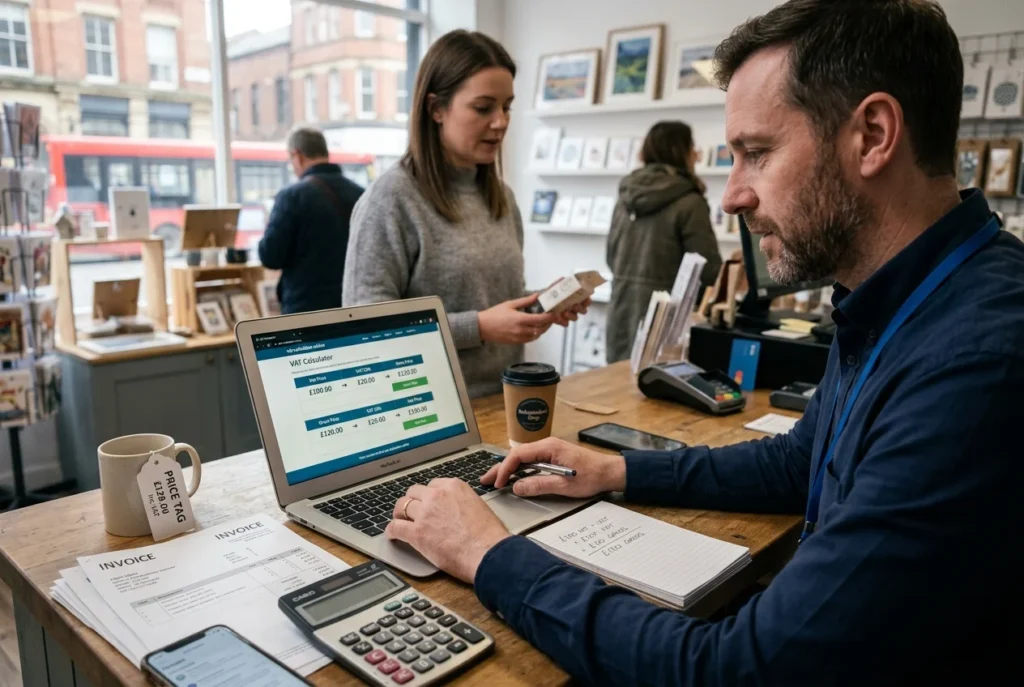
- £100 excluding VAT → £120 including VAT
- £120 including VAT → £100 excluding VAT
- VAT included in £120 → £20
This distinction matters when checking supplier costs, customer quotes, invoices, and product prices.
HMRC also provides guidance on working out VAT-inclusive and VAT-exclusive prices when charging VAT.
VAT Calculations for Small Businesses
Small businesses often need to switch between net prices, VAT amounts, and gross prices. The basic calculation depends on whether VAT needs to be added or removed.
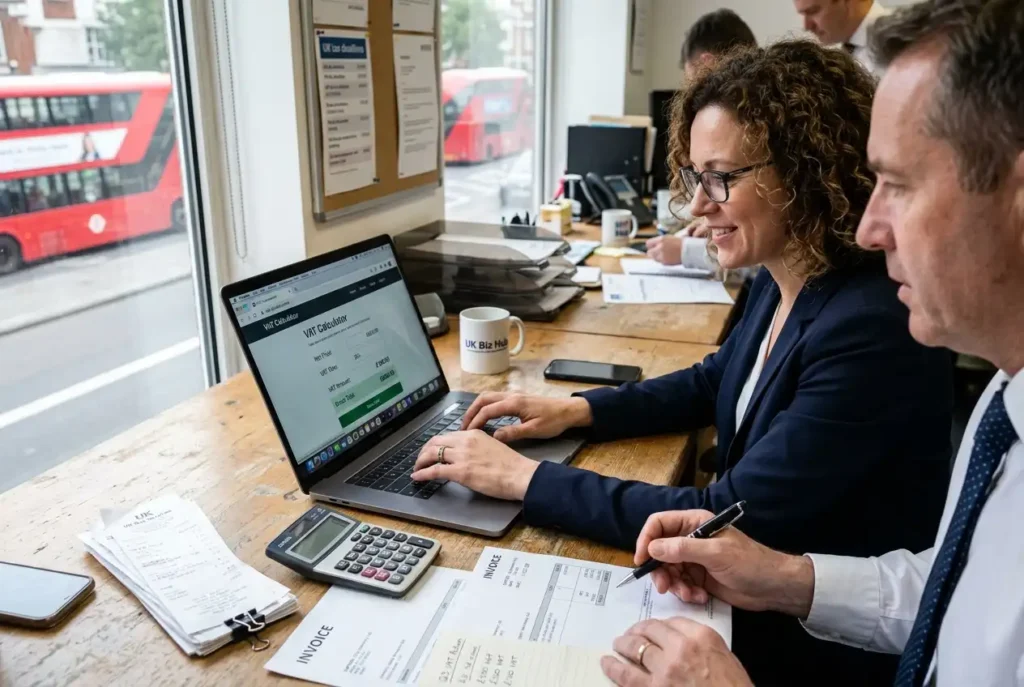
At a 20% VAT rate, adding VAT to £1,000 gives £200 VAT and a total of £1,200. If £1,200 already includes 20% VAT, dividing it by 1.20 gives the £1,000 net amount.
The same approach can be used with other VAT rates, but the rate must match the transaction.
VAT calculations can also feed into a business VAT return. VAT charged on taxable sales is considered alongside VAT that the business is allowed to reclaim on eligible purchases. A calculator can check the arithmetic, while the business still needs to apply the VAT rules that relate to the transaction.
Industry-Specific VAT Calculation Considerations
Different industries can have VAT issues that go beyond a simple percentage calculation.
| Business Type | VAT Calculation Point |
| Retail | Product prices may be displayed with VAT included, while supplier costs may be recorded differently. |
| Hospitality | Different products or services can have different VAT treatment depending on the transaction. |
| Construction | Some qualifying construction services can fall under the domestic reverse charge rules. |
| Property | VAT treatment can depend on the type of property and supply. |
| Exports | Goods and services supplied outside the UK can have different VAT rules depending on the circumstances. |
| Professional services | VAT is often added to fees when the business is VAT registered and the service is taxable. |
Construction businesses need to take particular care because the domestic reverse charge can apply to qualifying building and construction services when the required conditions are met.
A calculator can handle the percentage calculation once the correct VAT treatment is known.
VAT Calculations for Barbers
A VAT-registered barbershop will normally add VAT to taxable services at the rate that applies to the service.
Suppose a haircut is advertised at £30 before VAT. At 20% VAT, the tax is £6, giving a customer price of £36.
If the barbershop instead advertises the haircut at £36 including 20% VAT, the net price is £30 and the VAT included is £6.
A barbershop may also have VAT on equipment, products, rent, software, or other business costs. Whether VAT on those costs can be reclaimed depends on the circumstances and the applicable VAT rules.
VAT Calculations for Engineers
An engineering business may use VAT calculations when preparing project quotes or checking the total cost of materials and services.
For a £2,500 engineering service charged at 20% VAT:
- Net service price = £2,500
- VAT = £500
- Customer total = £3,000
If the customer has already been quoted £3,000 including 20% VAT, the same calculation can be reversed to find the £2,500 net price.
Engineering businesses may also have VAT on software, equipment, materials, subcontractor costs, and other expenses. The amount that can be reclaimed depends on the circumstances and normal VAT recovery rules.
VAT on Shopify Sales
A VAT-registered business selling through Shopify needs to make sure the VAT settings used for its products and customers match the VAT rules that apply to those sales.
For a UK sale priced at £100 before VAT, a 20% VAT calculation gives £20 VAT and a £120 customer price. If the displayed price is £120 including VAT, the VAT portion is £20.
International Shopify sales can require different treatment depending on the customer’s location, the type of goods or services, and the rules applying to the supply. The calculator can work out the arithmetic, but the correct VAT treatment should be established separately before relying on the result.
Reclaiming VAT on Business Costs
A VAT-registered business may be able to reclaim VAT on eligible business expenses. Common areas where VAT can arise include:
- Equipment and business supplies
- Stock and materials
- Professional services
- Business software and subscriptions
- Utilities and operating costs
- Other purchases used for taxable business activities
The business should keep the required VAT records and supporting invoices. Not every expense automatically qualifies for a VAT claim. Private use, mixed business and personal use, and specific VAT restrictions can change the amount that can be reclaimed.
For mixed-use costs, HMRC says a business can generally reclaim only the business proportion of the VAT when an item is used for both business and personal purposes. Valid VAT invoices and supporting records are also required.
VAT paid before registration may also be recoverable in certain circumstances. HMRC currently allows claims for qualifying goods bought within 4 years before registration and qualifying services bought within 6 months, subject to the relevant conditions.
FAQs
Final Thoughts
A Business VAT Calculator can make everyday VAT calculations easier when you are pricing products, preparing quotes, checking invoices, or reviewing business costs. The main thing is to know whether your starting figure is before or after VAT and use the rate that applies to the transaction.
For sales, you can calculate the VAT added to a net price or work backwards from a VAT-inclusive amount. For business purchases, separate the VAT from the total cost and check whether that VAT is eligible for recovery. Mixed-use costs, pre-registration purchases, deposits, and industry-specific transactions may need extra care.
The calculator handles the arithmetic, while your VAT records and the rules for the transaction determine what should actually be charged or reclaimed. Keeping invoices and other supporting records makes it easier to check your figures later. HMRC requires VAT-registered businesses to maintain VAT records and use them when completing VAT returns.
When you next review your business prices or expenses, are you starting with a VAT-inclusive or VAT-exclusive amount?