Ireland VAT Calculator
Ireland VAT Calculator
VAT rate: 23% standard Irish VAT. Reduced rates exist for some goods and services.
If you sell to customers in Ireland, or you buy from an Irish supplier, VAT is part of almost every price you see. Ireland calls this tax VAT, short for value added tax, and it works the same way as VAT in other countries. The seller adds it to the net price, the buyer pays the gross price, and a VAT registered business settles the difference with the tax office. This page explains the Irish rates in plain language and gives you a calculator that adds or removes Ireland VAT in seconds.
Use the tool above when you need a quick answer. Type any amount in euros, choose Add VAT or Remove VAT, and the calculator shows the net amount, the VAT amount, and the gross amount. It uses the standard Irish rate of 23 percent, which covers most goods and services. The rest of this page explains when the reduced rates of 13.5 percent, 9 percent and 4.8 percent apply, shows a worked example, and covers the registration and invoicing basics that matter if you sell in Ireland. If you sell across Europe, our EU VAT calculator compares the standard rates across the member states, and our UK VAT calculator covers the rates that apply in the United Kingdom. You can also return to the VAT calculator homepage at any time for the full set of tools.
Ireland VAT rates: standard and reduced
Ireland has four VAT rates. The standard rate is 23 percent and it applies to most goods and services, from electronics and clothing to restaurant meals and most professional services. The reduced rates are 13.5 percent, 9 percent and 4.8 percent, and each one applies to a narrower list of goods and services. Knowing which rate fits your sale matters, because the wrong rate means the wrong price and the wrong VAT return. A small error in the rate can change the total on every invoice, and it can also change the amount you report to the tax office.
The 13.5 percent rate covers many services and certain goods. It applies to categories such as building and repair services, and to certain goods such as fuel and some food products. The 9 percent rate covers restaurant and catering services, hotel accommodation and other tourist accommodation, newspapers, and some tourism and hospitality services. The 4.8 percent rate is the lowest and covers livestock, animal feed, and some agricultural products. The exact scope of each rate is set by Irish tax law, and borderline cases exist, so check the category for your product before you pick a rate. The same product can fall under different rates depending on how and where it is sold.
The calculator on this page uses the standard rate of 23 percent, because that is the rate most sellers meet most often. If your sale qualifies for a reduced rate, work out the VAT by hand with the same method shown in the worked example below, or ask your tax adviser to confirm the category. Reduced rates exist for some goods and services, and the calculator note above the results reminds you of that. For comparison, our Germany VAT calculator uses a standard rate of 19 percent, and our France VAT calculator uses a standard rate of 20 percent. Our Netherlands VAT calculator uses a standard rate of 21 percent, and our Poland VAT calculator also uses a standard rate of 23 percent.
How to use the Ireland VAT calculator
The tool takes seconds once you know what each option does:
- Enter the amount. Type the price in euros. Use the net amount if you want to add VAT, or the gross amount if you want to remove VAT.
- Choose Add VAT or Remove VAT. Add VAT starts from the net price and adds 23 percent. Remove VAT starts from the gross price and pulls the VAT back out.
- Read the three results. The tool shows the net amount, the VAT amount, and the gross amount, so you can copy the figure you need into a quote, an invoice, or a receipt check.
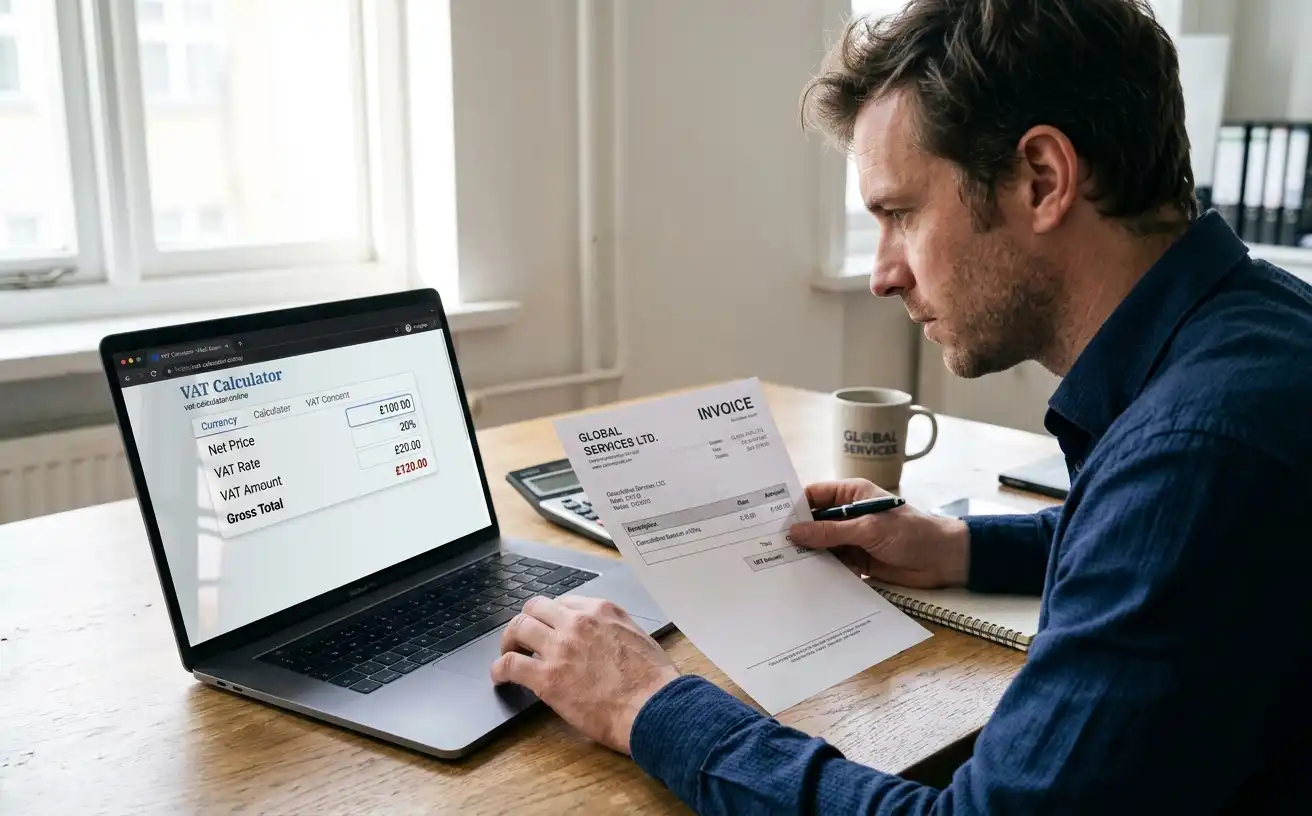
Use the calculator before you send a quote, so the customer sees the correct gross price. Use it again when you check a supplier invoice, so you can confirm that the VAT shown on the invoice matches the rate for the goods or services you bought. If the numbers do not match, ask the supplier to check the invoice before you pay it or record it in your accounts.
Worked example: 100 euros at 23 percent
A simple example shows the maths. Suppose you sell a lamp in Ireland for a net price of 100 euros, and the standard rate applies.
- VAT: 100 euros times 23 percent equals 23 euros.
- Gross price: 100 euros plus 23 euros equals 123 euros.
So the customer pays 123 euros, and 23 euros of that is VAT. Going the other way, start from a gross price of 123 euros. The VAT inside that price is 123 euros times 23 divided by 123, which is 23 euros, and the net price is 123 euros minus 23 euros, which is 100 euros. The calculator does both directions for you, and it rounds the results to the cent, which keeps your invoices tidy.
You can use the same method for any amount. For a net price of 50 euros at 23 percent, the VAT is 11.50 euros and the gross price is 61.50 euros. For a net price of 250 euros at 23 percent, the VAT is 57.50 euros and the gross price is 307.50 euros. If you work with a reduced rate, replace 23 percent with the rate for your product and follow the same two steps. Multiply by the rate to add VAT, or divide by one plus the rate to remove VAT.
Registration and invoicing basics in Ireland
If you run a business that sells goods or services in Ireland, you may need to register for VAT with Revenue, the Irish tax authority. Registration matters because it lets you charge VAT on your sales and reclaim the VAT you pay on business purchases, and because your invoices must show the correct VAT details. The rules depend on where your business is based, what you sell, and how much you sell, so check your own position before you start trading. A business based outside Ireland may face different registration rules from a business based in Ireland, especially if it sells goods that are stored in Ireland or services that are treated as supplied in Ireland.
Ireland sets registration thresholds based on turnover, and the threshold differs for businesses that supply goods and businesses that supply services. If your turnover stays below the relevant threshold, you may not need to register, and voluntary registration is possible in some cases. Voluntary registration can suit a business that wants to reclaim VAT on its purchases, but it also brings the full set of VAT duties, including charging VAT and filing returns. If you are near a threshold, check the current figures and rules with Revenue or your adviser, because thresholds and details change over time.
An Irish VAT invoice normally shows the seller name and address, the buyer name and address, the seller VAT number, a sequential invoice number, the date of issue, a description of the goods or services, the net amount, the VAT rate applied, the VAT amount, and the gross amount. Keep copies of your invoices and your VAT records, because Revenue can ask to see them later. If you sell to customers in other countries, read our EU VAT calculator page for the cross border rules that apply inside the European Union.
Good record keeping also makes VAT returns easier. Keep a clear list of your sales, your purchases, the VAT you charged, and the VAT you paid. When the return period ends, you can work out the difference and check it against your invoices. If a figure looks wrong, trace it back to the invoice or receipt that created it, rather than changing the total by hand. This habit saves time and it reduces the chance of a mistake that carries forward into the next return.
Frequently asked questions
What is the standard VAT rate in Ireland?
The standard VAT rate in Ireland is 23 percent. It applies to most goods and services, including electronics, clothing, restaurant meals, and most professional services.
What are the reduced VAT rates in Ireland?
Ireland has three reduced VAT rates: 13.5 percent, 9 percent and 4.8 percent. The 13.5 percent rate covers many services and certain goods, the 9 percent rate covers tourism and hospitality services such as hotel stays and restaurant meals, and the 4.8 percent rate covers livestock, animal feed, and some agricultural products.
How do I add 23 percent VAT to a net price?
Multiply the net price by 0.23 to find the VAT, then add that VAT to the net price. For a net price of 100 euros, the VAT is 23 euros and the gross price is 123 euros.
How do I remove VAT from a gross price in Ireland?
For the standard rate, divide the gross price by 1.23 to get the net price, then subtract the net price from the gross price to get the VAT. For a gross price of 123 euros, the net price is 100 euros and the VAT is 23 euros.
Do I need to register for VAT in Ireland?
It depends on your turnover and what you supply. Ireland sets registration thresholds based on turnover, and the threshold differs for goods and services. If your turnover stays below the relevant threshold, you may not need to register, and voluntary registration is possible in some cases. Check the current thresholds and rules with Revenue or your adviser.
What should an Irish VAT invoice show?
An Irish VAT invoice normally shows the seller and buyer details, the seller VAT number, a sequential invoice number, the date of issue, a description of the goods or services, the net amount, the VAT rate, the VAT amount, and the gross amount.
Final Thoughts
Irish VAT is simple once you know the four rates and the two directions of the calculation. Most sales use 23 percent, smaller lists use 13.5 percent, 9 percent or 4.8 percent, and the calculator above handles the standard rate for you in both directions. Work through the example with your own figures, check the category when a reduced rate might apply, and keep your invoices complete. If you also sell into other markets, the EU VAT calculator, the UK VAT calculator, the Netherlands VAT calculator, and the Poland VAT calculator on this site can help you price those sales correctly.