VAT Exemptions UK: What Items Are Exempt
If you sell goods or services in the UK, it helps to know whether VAT applies to what you sell. Some supplies are taxable, some are exempt, and some are outside the scope of VAT. These three categories sound similar, but they work in different ways and they have different effects on prices, invoices, records and VAT returns. This guide explains what VAT exempt items UK rules cover in general terms, how exempt supplies differ from zero rated supplies and supplies that are outside the scope of VAT, and what exemption means for a business that makes exempt supplies.
It is general information only and not tax advice. VAT rules can be detailed and they can depend on the exact nature of a supply. Always check the current HMRC guidance or ask a qualified professional before you act. If you are setting prices, our UK VAT calculator can help you check the VAT on a net or gross amount.
Exempt, Zero Rated and Outside the Scope: What Is the Difference
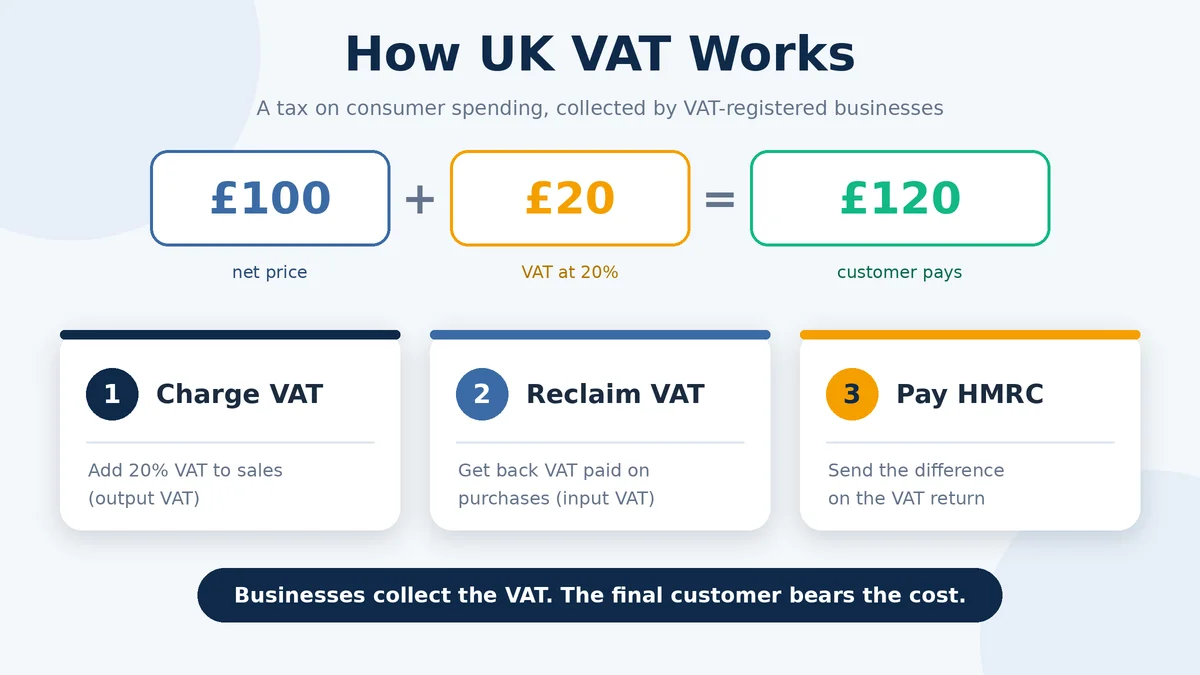
VAT exempt means that no VAT is charged on the supply. The seller does not add VAT to the price, does not show VAT on the invoice for that supply, and does not account for output VAT on it. The important point for a business is that input VAT linked to an exempt supply generally cannot be reclaimed. In other words, the VAT a business pays on costs that relate only to exempt supplies normally stays as a cost to that business.
Zero rated means that VAT is charged at a rate of zero. No VAT is added to the price, so the customer pays the same amount as the net amount. The difference from exemption is on the input VAT side. Input VAT linked to zero rated supplies can generally be reclaimed, subject to the normal VAT return rules. A business that makes zero rated supplies is still making taxable supplies, even though the rate is zero. That point matters for VAT registration and for VAT returns.
Outside the scope of VAT means that the supply is not part of the UK VAT system at all. No VAT is charged, and the supply is not treated as a taxable supply or as an exempt supply. It is a separate category. For example, a supply that does not take place in the UK for VAT purposes, or a supply that is not a business supply in the VAT sense, may be outside the scope. The treatment depends on the facts, so it is important not to assume that every supply with no VAT on it is exempt.
- Exempt: no VAT charged, and input VAT on the exempt supply generally cannot be reclaimed.
- Zero rated: VAT charged at zero, no VAT added to the price, and input VAT can generally be reclaimed.
- Outside the scope: not part of the UK VAT system, so it is neither taxable nor exempt.
Getting the category right matters. It affects how you price your goods or services, what you show on invoices, whether you can reclaim input VAT, and how you complete your VAT return. If you are unsure which category applies, keep clear records of what was supplied and seek advice before you file.
VAT Exempt Categories in the UK
UK VAT law sets out a list of exempt supplies. The list is specific, and a supply is exempt only if it falls within one of those categories and meets the relevant conditions. The categories below are well established examples. They are described in general terms. Do not assume that every service in a broad area is exempt, because the detail can matter.
- Financial services: many financial services are exempt, such as lending, credit and some related services provided by financial businesses.
- Insurance: insurance transactions are generally exempt, including the provision of insurance cover and related services by insurers and brokers in the usual course of that business.
- Education and training: education and vocational training provided by eligible bodies can be exempt, where the relevant conditions are met.
- Health and welfare: many health services and welfare services are exempt, where they are provided by suitable providers and meet the relevant conditions.
- Land and property: some land and property transactions are exempt, while others are taxable. The treatment can depend on the type of transaction and whether an option to tax applies.
- Other exempt areas: some postal services, betting and gaming, and some cultural, sporting and charitable activities can be exempt where the relevant conditions are met.
The key point is that exemption follows the nature of the supply and the conditions that apply to it, not only the general label. Two supplies that look similar can be treated differently if one meets the exemption conditions and the other does not. That is why it helps to look at the contract, the invoice description and the HMRC guidance for the relevant category, and to keep a note of why you treated a supply as exempt.
What Exemption Means for a Business
If your supplies are exempt, you do not charge VAT on those supplies and you do not add VAT to your prices for them. Your invoices for exempt supplies should not show VAT as if it had been charged. This can make pricing simpler for customers who cannot reclaim VAT, because the price they see is the price they pay. It also means that your exempt sales do not create output VAT that you must pass to HMRC.
The other side of exemption is input VAT. A business that makes only exempt supplies generally cannot reclaim input VAT on its business purchases. That VAT becomes part of the cost of running the business. When you compare prices from suppliers, it helps to remember that a VAT registered business that makes taxable supplies can often reclaim input VAT, while a business that makes only exempt supplies generally cannot. For help with the rates that apply to taxable supplies, see our guide to UK VAT rates.
Exemption also affects record keeping. Keep clear records that show which supplies were exempt and why, along with invoices, contracts and receipts. Good records make it easier to complete VAT returns, to answer questions from HMRC, and to show that you applied the rules consistently. If your business later starts to make taxable supplies, or stops making exempt supplies, update your records and review your VAT position.
Partial Exemption Basics
Many businesses make a mix of taxable and exempt supplies. For example, a business may sell some taxable goods or services and also provide an exempt service. Such a business is often called partly exempt. Partial exemption rules deal with how much input VAT such a business can reclaim.
In general terms, input VAT that relates only to taxable supplies can be reclaimed, subject to the normal rules. Input VAT that relates only to exempt supplies generally cannot be reclaimed. Input VAT that relates to both taxable and exempt supplies, such as general overhead costs, needs to be split. The business uses a method to work out a fair share that relates to taxable supplies and a fair share that relates to exempt supplies. The method should be reasonable, consistent and supported by records.
- Identify which supplies are taxable and which are exempt.
- Separate input VAT that relates only to taxable supplies from input VAT that relates only to exempt supplies.
- Split mixed input VAT on a fair and consistent basis.
- Keep records that show how you reached the split.
- Review the position if the mix of supplies changes.
Partial exemption can be detailed, and the correct method can depend on the type of business and the pattern of supplies. If the amounts are large, or the mix changes often, it is sensible to get advice from a qualified professional. You can learn more about the reclaim process in our guide on how to reclaim VAT, and about registration in our guide on how to register for VAT in the UK.
How to Check Whether a Supply Is Exempt
When you are unsure whether a supply is exempt, start with the nature of the supply itself. Ask what is actually being provided, who is providing it, and whether it falls within a recognised exempt category. Look at the contract or agreement, the invoice description and any terms that describe the service. Then check the current HMRC guidance for that category. If the answer is still not clear, ask a qualified professional before you treat the supply as exempt or taxable.
- Describe the supply in plain terms, so you can match it to the correct VAT category.
- Check whether an exemption condition applies to that type of supply and provider.
- Look at the invoice and contract to make sure the description matches what was actually supplied.
- Keep a note of the guidance you relied on and the date you checked it.
Check VAT on Your Prices
Once you know whether your supplies are exempt, zero rated or taxable, check how VAT affects your prices. Our UK VAT calculator works out the VAT on a net or gross amount at the UK standard rate, so you can set prices, prepare quotes and check invoices with confidence. For the rates that apply to taxable supplies, see our guide to UK VAT rates.
Frequently Asked Questions
What does VAT exempt mean in the UK?
VAT exempt means no VAT is charged on the supply and the supplier generally cannot reclaim input VAT that relates to that exempt supply. The supply is still part of the business activity, but it is treated differently from taxable supplies for VAT purposes.
What is the difference between exempt and zero rated?
Exempt supplies have no VAT charged and input VAT on them generally cannot be reclaimed. Zero rated supplies have VAT charged at a rate of zero, so no VAT is added to the price, but input VAT linked to those supplies can generally be reclaimed. That difference matters for pricing, record keeping and VAT returns.
What items are exempt from VAT in the UK?
Well established exempt categories include many financial services, insurance, education and training provided by eligible bodies, health and welfare services, and some land and property transactions. The exact treatment depends on the nature of the supply, so check the relevant HMRC guidance or ask a qualified professional.
Can I reclaim VAT if my supplies are exempt?
Generally no. A business that makes only exempt supplies generally cannot reclaim input VAT on costs linked to those supplies. If a business makes both taxable and exempt supplies, it may be partly exempt and may reclaim input VAT linked to its taxable supplies, subject to the partial exemption rules.
Does exempt mean the same as outside the scope of VAT?
No. Exempt supplies are within the VAT system but no VAT is charged on them. Supplies that are outside the scope of VAT are not part of the UK VAT system at all, so they are treated differently again. Getting the category right matters because it affects VAT returns, records and whether input VAT can be reclaimed.
Do I need to register for VAT if all my sales are exempt?
If all your supplies are exempt, you generally do not need to register for VAT on the basis of those supplies alone, because exempt supplies are not taxable supplies. If your position changes, or you also make taxable supplies, check the registration rules and seek advice if you are unsure.
VAT Calculator provides VAT calculations and information for general informational purposes only. Calculator results are estimates and should not be considered tax, legal, accounting, or financial advice. VAT rates and rules may change, so please verify important information with official sources or a qualified professional before making financial or tax decisions.