Value Added Tax in the UK
Value Added Tax (VAT) is a tax charged on most goods and services supplied by VAT-registered businesses in the UK. The amount of VAT depends on the type of goods or service and the rate that applies to the supply.
For customers, VAT is often included in the price they pay. VAT-registered businesses collect VAT from customers and account for it to HMRC, while eligible VAT paid on business purchases can usually be taken into account when working out the amount due.
The UK VAT system has different rates and categories, including the standard, reduced and zero rates. Some goods and services are also exempt from VAT, so the correct treatment depends on what is being supplied and the circumstances.
What Value Added Tax Means in the UK
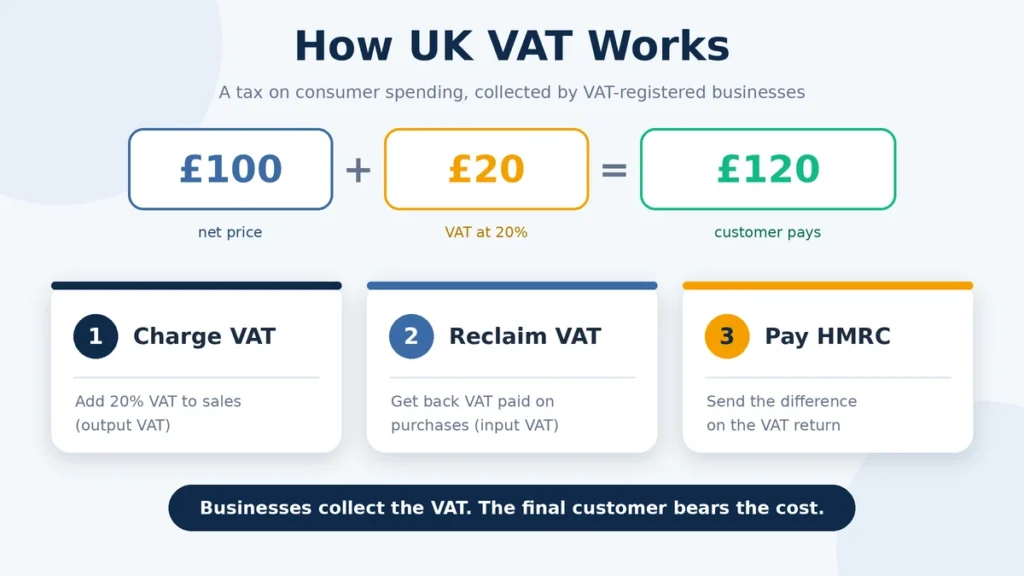
VAT is accounted for as goods and services move through the supply chain. A VAT-registered business adds VAT to taxable sales, collects it from its customers, and records the VAT it has charged and paid. The business then reports these amounts to HMRC through its VAT return.
For the customer buying the final product or service, VAT is usually part of the price paid. The business does not treat the VAT it collects as its own income. Instead, it accounts for the tax through the VAT system, while eligible VAT paid on business purchases can be taken into account when calculating the amount due to HMRC.
How VAT Works Through the Supply Chain
VAT follows goods or services through the different stages of the supply chain. At each stage, a VAT-registered business charges VAT on its taxable sales and records eligible VAT paid on business purchases. It then reports these figures to HMRC through its VAT return.
- A supplier sells goods or services to a VAT-registered business and charges the applicable VAT.
- The business records the VAT it paid on that purchase.
- The business later sells the goods or services and charges VAT to its customer.
- It records the VAT collected from that sale.
- When submitting its VAT return, it works out the difference between VAT charged and eligible VAT paid.
- When VAT charged is higher than eligible VAT paid, the business normally pays the difference to HMRC.
- When eligible VAT paid is higher than VAT charged, the business will usually be due a repayment from HMRC.

This means VAT is accounted for as goods or services move through the supply chain rather than being charged only at the final sale. The final customer generally bears the VAT included in the price, while VAT-registered businesses account for the VAT they charge and the eligible VAT they pay.
Who Charges VAT and Who Ultimately Bears the Cost
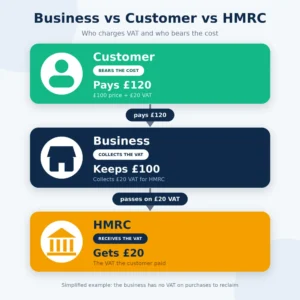
AT-registered businesses charge VAT on taxable goods and services at the rate that applies to the supply. The business collects the VAT from its customers and reports the VAT charged and eligible VAT paid through its VAT return.
The final customer generally bears the cost of VAT because the tax forms part of the price paid for the product or service. The business collects and accounts for the VAT rather than treating it as its own income. The amount paid depends on the VAT rate and whether the displayed price already includes VAT.
VAT vs Sales Tax and GST
| Tax System | How It Generally Works | Where the Tax Is Accounted For |
| VAT | Tax is accounted for through different stages of the supply chain, with VAT-registered businesses accounting for VAT charged on sales and eligible VAT paid on purchases. | Each VAT-registered business accounts for its VAT through the VAT system. |
| Sales tax | Tax is generally collected on taxable sales to the final customer rather than through each stage in the same way as VAT. | The seller usually collects the tax at the point of sale. |
| GST | Goods and Services Tax generally follows a value-added model, with registered businesses accounting for tax collected and eligible input tax credits. | Registered businesses account for GST through the relevant tax system. |
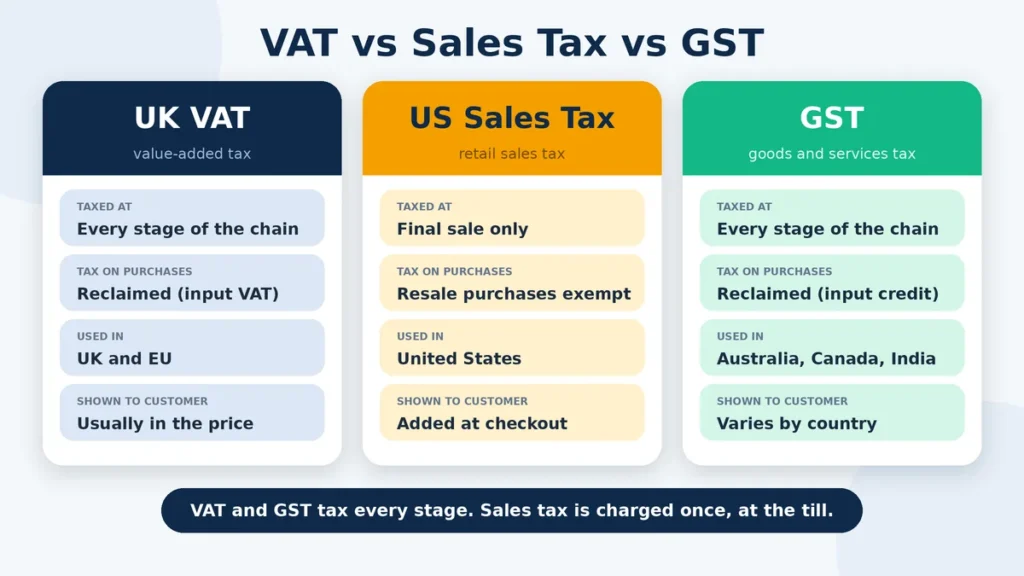
The main difference is how the tax is collected and accounted for. UK VAT works through the supply chain, with VAT-registered businesses reporting VAT charged on sales and eligible VAT paid on purchases.
The terms also vary between countries. GST is often used for a tax that works in a similar value-added way, while sales tax commonly refers to a tax collected on the final sale. The exact rules depend on the country, so the name alone does not tell you how a particular tax system operates.
When VAT Registration Becomes Relevant
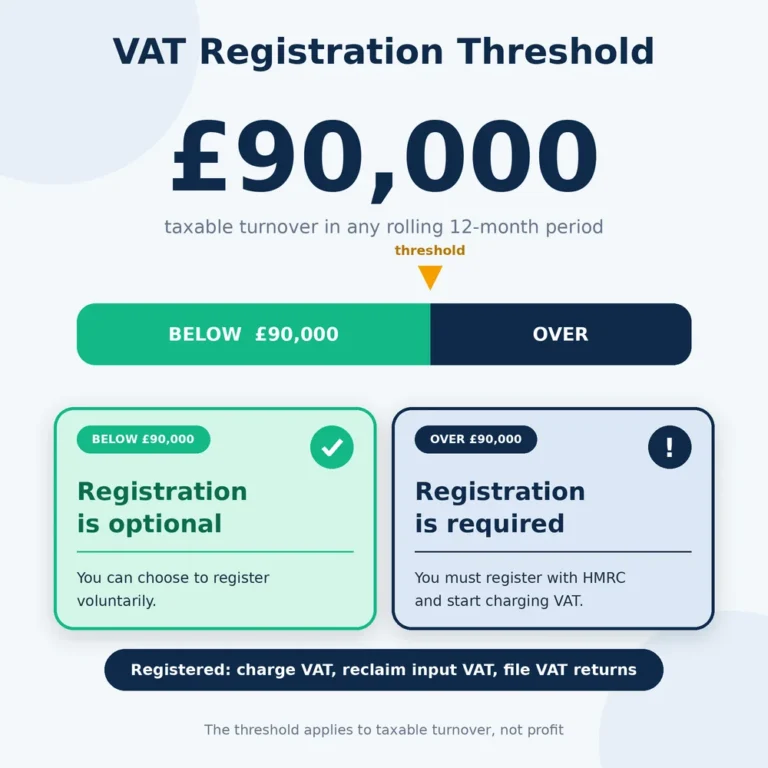
VAT registration becomes relevant when a business reaches the UK VAT registration threshold or expects its taxable turnover to exceed the threshold within the next 30 days. The current registration threshold is £90,000. A business can also choose voluntary registration when its taxable turnover is below £90,000.
The threshold is based on taxable turnover. Standard-rated, reduced-rated and zero-rated supplies generally count towards this figure, while exempt and out-of-scope supplies are treated differently.
Businesses based outside the UK can also have VAT registration obligations when they make taxable supplies in the UK. The rules can differ from those that apply to UK-established businesses, so the circumstances of the supply need to be considered.
FAQs
Final Thoughts
VAT in the UK affects businesses and customers at different points in a transaction. VAT-registered businesses charge the applicable rate on taxable sales, keep records of VAT charged and eligible VAT paid, and report the figures to HMRC. Customers generally bear the final cost when VAT is included in the price.
Knowing the difference between standard, reduced, zero-rated, exempt, and outside-the-scope supplies can help avoid common VAT mistakes. It is also useful to know when VAT registration becomes relevant and whether a supplier is actually VAT registered.
The basic VAT system is easier to follow when you separate three things: the type of supply, the VAT rate, and who is responsible for accounting for the tax.
When you deal with a VAT-inclusive price, do you know which part of the amount represents VAT?